Wednesday, February 21, 2024

Three Strange Years: Daily Life During the COVID-19 Pandemic


Three copies of a book are laid on the ground, surrounded by dry leaves. Two of the books are wearing face masks, one a homemade cloth mask and the other a blue disposable mask. The book in the middle is uncovered and can be seen clearly. The book cover features strawberries against a background of COVID virus, with the words "Three Strange Years: Daily Life During the COVID-19 Pandemic."

My pandemic diary is now available in paperback! I kept the diary on social media while COVID-19 was upending everything, and it seemed important to preserve it, so it's now available on Amazon here. Obviously I've been working on this one for a while, since I started writing it at the end of March 2020. Originally it was simply meant to fight loneliness while everything was shut down, but it grew into a detailed look at daily life over three historic and really strange years. At heart it's a celebration of family love and simple pleasures--novice gardening and other new hobbies, socializing at a distance, and being there for each other the best way we knew how. The ups and downs of life during the pandemic, captured in real time, are never to be forgotten. 

Monday, December 25, 2023

Christmas Angels

On a small Christmas tree with colored lights, three matching angel tree toppers with Christmas lights for hands surround a paper doll based on the angel from the book "The Angel's Name."

Merry Christmas! My internet hasn't been working at home lately, so I haven't blogged as much as I'd like. But I wanted to share this picture of my story-book angel with her real-life inspiration, plus two more "twin" angels--I guess they are triplets now--that I bought on eBay because my sister has the one that belonged to our grandparents (We spent Christmas together this year, so the angels did, too). They do all have their own names, of course. (Faith, Charity, and Mercy, since the book angel is Hope!) Faith was the original angel who needed a name--a previous post with a picture of her and the book she inspired can be found here.  Paper dolls of Hope are here and here, and a printable Nativity stable to go with them is here. Merry Christmas again!
 

Friday, December 1, 2023

Temple of Fancy Paper Dolls--Ellen, or The Naughty Girl Reclaimed


An old-fashioned paper doll is shown in two similar outfits, one clean and the other spotted with mud.


Here is another of the early paper dolls originally sold by S & J Fuller at the Temple of Fancy art supply store in London. Ellen, or the Naughty Girl Reclaimed was published in 1811 and is said to have been a favorite of Queen Victoria when she was a little girl. Like Little Fanny and Little Henry, which I blogged about here, Ellen's head is separate from her body and can be slotted into a paper pocket in the top of each of her outfits. I have constructed her in the same way as the others, gluing her onto paperboard for sturdiness. Ellen's story is, like Fanny's and Henry's, very much a product of its time. Ellen, the "naughty girl," refuses to do as she is told, eventually going through enough hardship as a result that she learns her lesson and reforms.  I especially enjoy that one of Ellen's outfits is shown in two states, before and after she falls into a muddy ditch. 


Two old-fashioned paper dolls are shown wearing very similar blue hats with white plumes.


The hat from that particular outfit looks strikingly like Little Fanny's fancy hat, so I'm throwing in a picture of Ellen and Fanny wearing their matching hats. The outfits are not as similar; I'm not sure if that's a result of changing fashions or just Fanny wearing her winter coat and muff in the wrong season, as she does in her story. Ellen also has a red cloak and basket ensemble that looks a lot like two of Fanny's market outfits. It would be easy to confuse some of these pieces.


An old-fashioned paper doll is shown in two different outfits, one with a dunce cap and the other a ragged outfit. In the ragged outfit the doll is shown lying under some trees.


Ellen also comes with a dunce cap and a beggar's outfit. I'm not sure why the beggar's outfits were so popular for these dolls, but Little Fanny and Little Henry have them too. They can all stand around looking disreputable together while they wait to be changed into nicer clothing. 


Three old-fashioned paper dolls are shown wearing beggar outfits.


Download PDF files of Ellen and her outfits here and here.  


page 1 of Ellen the paper doll


page 2 of Ellen the paper doll


Friday, November 3, 2023

Bartrug's Mother Goose Rhymes--Coloring Books


Three square coloring books are laid in a vertical row. "My Mother Goose Safety Rhymes Coloring Book" has a blue cover, "My Mother Goose Health Rhymes Coloring Book" has a green cover, and "My Mother Goose Etiquette Rhymes Coloring Book" has a purple cover. All the covers are decorated with black and white images of various nursery rhyme characters.

Some time ago I was looking for old nursery rhyme books on the Library of Congress website, and I ran across a quite interesting one by Carey Milton Bartrug. Mother Goose Safety Rhymes was published in 1940, but the Library of Congress lists it as being in the public domain because the copyright was never renewed. I looked up the author's obituary, and it seems that the copyright was not renewed because Carey Milton Bartrug died in 1952, before the time came to renew it. (The Library of Congress people checked for copyright renewal in 2019 and didn't find it, and I'm pretty sure they would know.) His obituary and a picture of his headstone can be found here on the Find a Grave website. He sounds like exactly the sort of person to write nursery rhymes about safety; he was superintendent of schools in Iowa Falls from 1928 until 1945, and then he ran an insurance agency. Besides the nursery rhyme book, he wrote an entire series of workbooks about a character called Safety Sam. 

An old book page shows Old Mother Hubbard falling off a chair while trying to get a bone for her dog. The text reads, "Old Mother Hubbard went to the cupboard, to get her poor dog a bone. But when she got there, she fell off the chair, and so the poor dog had none. Always beware when standing on a chair."

I've chosen a relatively innocuous page from Mother Goose Safety Rhymes to show here; Old Mother Hubbard falls off a chair while getting a bone for her dog, and the helpful moral is given to "Always beware when standing on a chair." Besides standing on chairs, children who read the book are warned against swimming alone, playing with matches, touching loose wires, riding on bicycle handlebars, etc. Some of the pages are scarier than others. Anyway, it tickled my fancy because it's so very... blunt. Me being me, I jumped down a research rabbit hole and discovered that Bartrug and Peters made two more nursery rhyme books, one about health and the other about etiquette. Since the illustrations were done in black and white, I thought it would be fun to turn them into coloring books for my kids. 

A page colored by a child is shown, with the picture of a boy falling out of a boat and the words "Little Tee Wee: Little Tee Wee, he went to sea in an open boat; and while afloat the little boat bended--so my story's ended. Be careful in any boat." The facing page, originally blank, has also been colored and has a shark drawn on it in brown crayon by the child's mother.

My Mother Goose Safety Rhymes Coloring BookMy Mother Goose Health Rhymes Coloring Book, and My Mother Goose Etiquette Rhymes Coloring Book (which are all available on Amazon if you click on the links) are formatted with a blank back to each picture. Not only does that prevent the pages from showing through each other, it allows the pictures to be creatively extended by those who are coloring with crayon or colored pencil. Here is an example page from My Mother Goose Safety Rhymes Coloring Book that has been colored by my son. Little Tee Wee has carelessly put himself in danger by going out alone in a small boat and tipping it over, and my four-year-old decided to increase the danger by asking me to draw a shark on the facing blank page. This was a fun, relaxing little project. 

Tuesday, September 26, 2023

How to View Stereo Cards in 3D


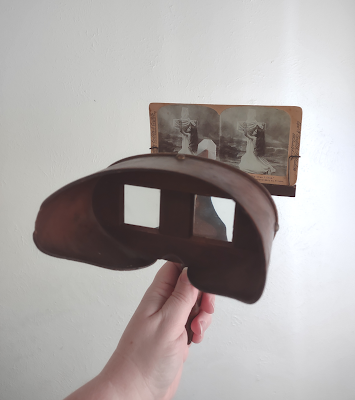
An antique wooden stereoscope holds a stereograph photo of a young girl clinging to a white-draped cross. A small bit of wood is missing from the stereoscope and has been replaced by white paperboard.


A friend asked me to explain on my blog how I view all these 3D pictures, so here is a post about that. First, here's a picture of my real, old-fashioned stereoscope. This particular one is marked on the bottom that it's a "Saturn" Scope, with patent dates of October 15, 1895 and February 1, 1896. It's a version of the Holmes stereoscope, which was invented in 1861 by Oliver Wendell Holmes, Sr. and deliberately not patented. Mine is missing a little piece of wood at the end of the part that divides the two views, so I've attached a bit of paperboard so each eye doesn't see the edge of the opposite view. Paper stereograph cards--the one shown here is the original of the last recolor I blogged about--sit in a holder that slides backward and forward to focus. Unfortunately it's easy to slide it all the way off, and therefore a lot of stereoscopes end up for sale without it. I have a second stereoscope that came in an eBay lot with this one, but it's missing both the card holder and the handle. I haven't yet tried to restore that one, beyond popping the glass lenses back in after they got knocked out during shipping. 
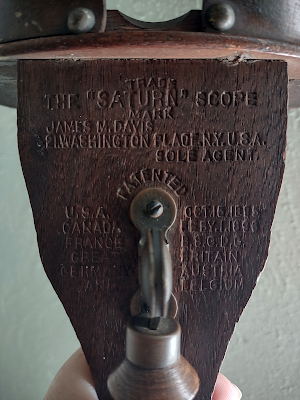

Carved into the bottom of a wooden stereoscope are the following words. Trade mark. The "Saturn" scope. James M. Davis. 21 Washington Place, N.Y. USA. Sole agent. Patented. U.S.A. Oct. 15 , 1895. Canada Feby 1, 1896. France B.S.G.D.G. Great Britain Germany Austria and Belgium.


Anyway, the general idea is that if you have two pictures taken from about as far apart as the distance between our eyes, you can show each picture to the correct eye and your brain will register the combination as a 3D object instead of a flat one. The first stereoscope, designed by Charles Wheaton in 1838, was a complicated affair involving mirrors and hand-drawn images. With the development of photography and the invention of the cheaper Holmes stereoscope, though, the technique became an extremely popular form of home entertainment. So many paper stereo cards were produced that a large number survived and are still available today. Prices vary wildly, and if you want something specific you might be in for a long search, but as antiques go they're quite accessible.
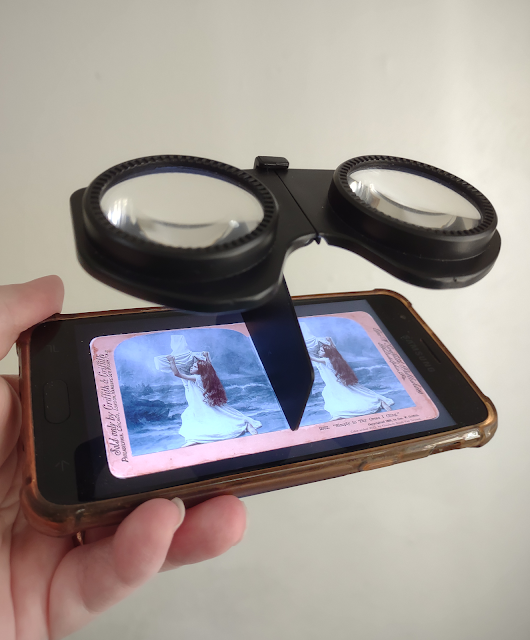
 

A smartphone displays a colored stereograph of a young girl clinging to a white-draped cross. Attached to the phone is a minimalist black plastic viewer consisting of a pair of lenses and a plastic clip.


It's not always convenient to get out a fragile, antique device, and the stereoscope needs good lighting. So more often I use this handy little modern gadget to view digital copies on my smartphone. Any headset compatible with the unfortunately discontinued Google Cardboard works, but I prefer this minimalist version I got on Amazon for $6.99. Here's a link to it; it's not an affiliate link or anything, I just haven't found anything cheaper or more effective. The product description doesn't make a lot of sense, but judging from the reviews I'm not the only one who likes it for viewing stereographs. To use it, just load the picture on a phone in landscape mode (turn on auto rotate) and clip the viewer right on the line between the two sides. Hold it by the phone and not by the viewer so as not to knock it out of alignment, and look into the lenses as if they were a pair of binoculars. Since this model has open sides, it's easy to swipe from one picture to the next. You can also zoom in and out to focus if necessary. And it folds up to about the size of your palm, so it's portable, too. I've had more than enough fun out of mine to justify the price, so I definitely recommend getting one of your own. 
 

A minimalist black plastic 3D viewer is shown folded up for storage. It fits easily in a hand.

Tuesday, September 19, 2023

Stereo Card Recolor--Simply to Thy Cross I Cling (1900)


I found this lovely stereograph card on eBay a while ago, and I colored it in Photoshop but didn't post it right away because it was so tricky to sort out the boundary between the painted backdrop and the girl's hair. Finally I decided to check it over it one more time and then go ahead and share, so here it is. I really like this card and have not seen it anywhere else.

This stereograph has a strong resemblance to one I blogged about earlier, here, ultimately based on a painting by Johannes Adam Simon Oertel. It seems to have been a popular design to copy; several other companies put their own spin on it. I've collected a few of them and find it fascinating just how much variety there is even when they're clearly copying each other. This particular version was published in 1900 by Griffith & Griffith. Since it's a photo and not a painting, the 3D effect is much more convincing than in the 1896 card. The cross is not made of rock--it appears to be cloth-draped wood--but the title is still a line from the song "Rock of Ages." The girl is younger than in many other portrayals; since she's understood to be a personification of Christian faith, I suppose that makes this one childlike Faith.

Thursday, September 14, 2023

A Apple Pie: An Active Alphabet--Pocket Size


A large 8.5x11 book sits next to a small 4x6 book as a size comparison. Both books are A Apple Pie: An Active Alphabet, by Kate Greenaway and Elizabeth Staab Van Deusen. The cover is blue and pink, with an illustration of a large pie and four small children with baking supplies.


I thought A Apple Pie: An Active Alphabet would make a cute mini book, so this summer I formatted a 4" by 6" pocket size version. It's a lot more portable than the original 8.5" by 11" book. The extra stuff in the back that I excluded from the ebook because of unreadably small print was also left out of the pocket size version, though, so you'll have to get the full-size book if you want a historical tour of the A Apple Pie nursery rhyme. The more streamlined mini book still has the same information in the back about Kate Greenaway, about me, and about the nursery rhyme, just without the example pages from other old books. Unfortunately the black-and-white picture of Kate Greenaway's dog also didn't fit, but that meant I could include the photo of Kate herself in its original sepia instead of having to make it grayscale to match. And I think she looks more natural and friendly in sepia. Anyway, I am quite pleased with how the mini book turned out. Find it on Amazon here

An American Girl Kirsten doll with blonde braids and a blue flowered dress holds a small book. The book is A Apple Pie: An Active Alphabet, by Kate Greenaway and Elizabeth Staab Van Deusen. The cover is blue and pink, with an illustration of four young children with baking supplies and a large pie.


This size of small book makes a perfect prop for 18" American Girl and similar dolls, so I got out my Kirsten doll to take some size comparison photos. My son was pretty goofy about having to sit next to her, but I wanted to show how well the pocket size book fits Kirsten compared to how the original book fits a real child. It's a fun option to have available.


A laughing small boy kneels next to an 18" doll as a size comparison. The boy is holding a large 8.5x11 book and the doll is holding a small 4x6 book.

A small boy sticks his tongue out at an 18" doll. The boy and the doll are each holding an appropriately-sized matching book.